

October 13, 2026
The case for upstream NLRP3 inhibition – efficacy
Javed Butler discusses the efficacy benefits of inhibiting NLRP3 upstream:
NOTE: Javed Butler is a consultant for Rezera.
The core efficacy question in cardiovascular inflammation is not simply whether a therapy lowers biomarkers in blood. It is whether the therapy reaches and meaningfully modifies the inflammatory processes within atherosclerotic plaque that contribute to cardiovascular events.
NLRP3 is a compelling mechanistic target because it links retained lipid to innate immune activation. Within atherosclerotic plaque, cholesterol crystals, oxidized lipids, cellular debris and other sterile danger signals activate the NLRP3 inflammasome in macrophages and foam cells. NLRP3 activation drives caspase-1-dependent maturation of both IL-1β and IL-18, initiating local inflammatory programmes that amplify vascular inflammation and contribute to downstream systemic inflammatory responses reflected by circulating IL-6 and hsCRP signalling. This provides a direct connection between plaque-associated danger signals, NLRP3 inflammasome activity and residual inflammatory cardiovascular risk.
That biology distinguishes NLRP3 inhibition from downstream cytokine blockade. Canakinumab neutralizes IL-1β after it has been produced and released, while ziltivekimab neutralizes IL-6 further downstream. A selective intracellular NLRP3 inhibitor, like ruvonoflast, is designed to reduce pathological maturation of IL-1β and IL-18 within inflammatory cells responding to danger signals in the arterial wall. The objective is not simply to lower a circulating cytokine or liver-derived biomarker, but to interrupt the pathological inflammatory cascade at its source, within plaque-associated inflammatory cells before maturation and release of IL-1β and IL-18. Clinical data generated to date with NLRP3 inhibitor ruvonoflast are consistent with this upstream mechanistic advantage, demonstrating a greater magnitude and breadth of inflammatory biomarker suppression than has historically been observed with IL-1β blockade with canakinumab (Figure).
FIGURE 1
IL-6 sits downstream from NLRP3 and IL-1β in the inflammation hierarchy
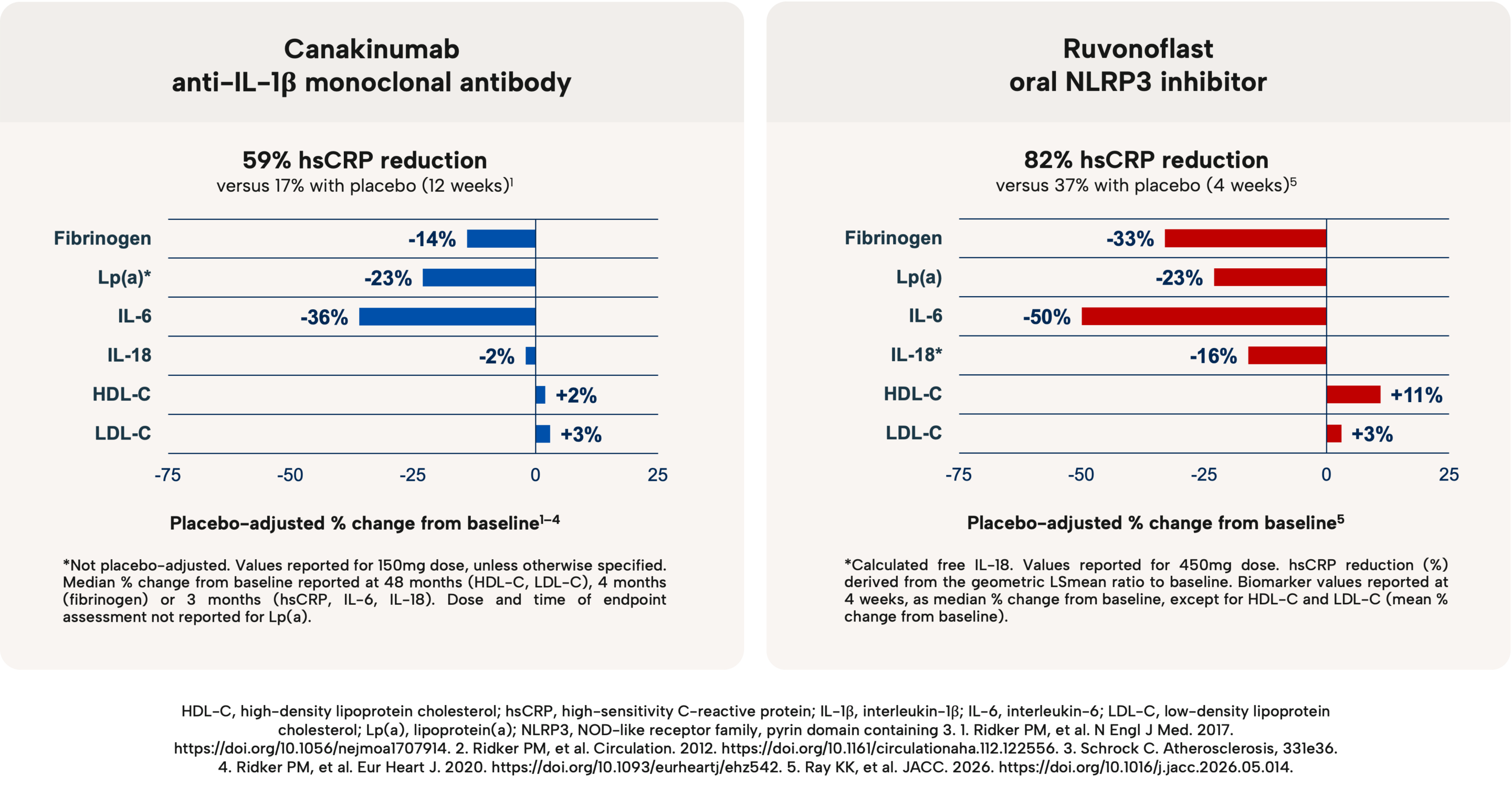
IL-18 strengthens this upstream rationale. NLRP3 activation produces both IL-1β and IL-18, not IL-1β alone. IL-18 amplifies a complementary IFNγ-driven immune programme associated with lymphocyte activation, plaque instability and cardiovascular risk. It therefore represents inflammatory biology not fully captured by the familiar IL-1β → IL-6 → hsCRP pathway or necessarily addressed by targeting a single downstream cytokine.
Taken together, these findings provide a strong rationale for evaluating direct, selective NLRP3 inhibition in clinical outcomes trials to determine whether upstream modulation of IL-1β and IL-18 translates into clinically meaningful improvements in patient function and reductions in cardiovascular events.
References:
Ray KK, et al. Anti-Inflammatory Effects of Oral NLRP3 Inhibition with Ruvonoflast Among Individuals at Elevated Cardiovascular Risk. J Am Coll Cardiol. 2026:S0735-1097(26)06570-8. https://doi.org/10.1016/j.jacc.2026.05.014.
Ridker PM. From C-Reactive Protein to Interleukin-6 to Interleukin-1: Moving Upstream to Identify Novel Targets for Atheroprotection. Circ Res. 2016;118(1):145-56. https://doi.org/10.1161/circresaha.115.306656.
Ridker PM, et al. Residual inflammatory risk associated with interleukin-18 and interleukin-6 after successful interleukin-1β inhibition with canakinumab: further rationale for the development of targeted anti-cytokine therapies for the treatment of atherothrombosis. Eur Heart J. 2020;41(23):2153-2163. https://doi.org/10.1093/eurheartj/ehz542.
Duewell P, et al. NLRP3 inflammasomes are required for atherogenesis and activated by cholesterol crystals. Nature. 2010;464(7293):1357-61. https://doi.org/10.1038/nature08938.
Ridker PM. From C-Reactive Protein to Interleukin-6 to Interleukin-1: Moving Upstream To Identify Novel Targets for Atheroprotection. Circ Res. 2016;118(1):145-56. https://doi.org/10.1161/circresaha.115.306656.