

October 8, 2026
hsCRP is a Marker, not a Map
Naveed Sattar, FMedSci, explains the value of hsCRP as a biomarker:
NOTE: Naveed Sattar is a consultant for Rezera.
In the ZEUS trial, IL-6 blocker ziltivekimab reportedly reduced hsCRP without concurrent reductions in cardiovascular events. In this context, it is important to be clear about the strength and limitations of high-sensitivity C-reactive protein, or hsCRP.
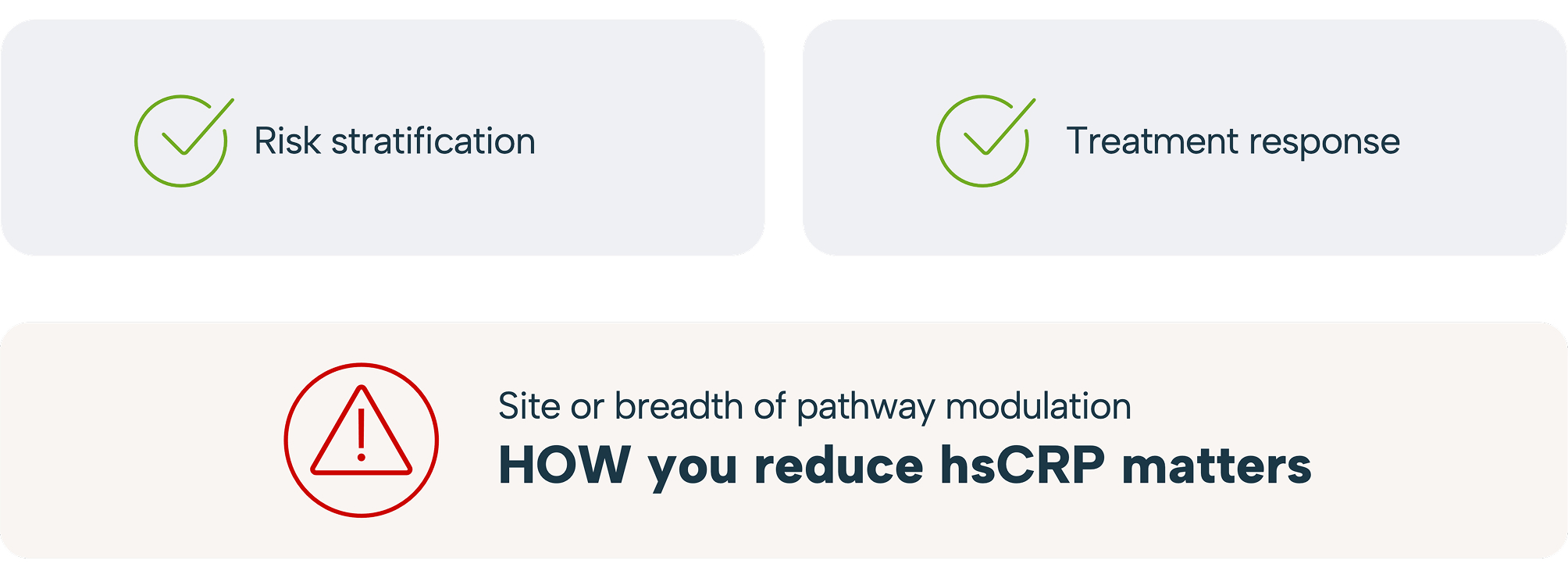
hsCRP is one of the most useful inflammatory biomarkers in cardiovascular medicine. Higher hsCRP identifies people at increased risk of future cardiovascular events. Moreover, changes in hsCRP can demonstrate that an anti-inflammatory therapy is engaging a systemic inflammatory pathway. But hsCRP is not a direct measure of vascular inflammation, nor does it identify which inflammatory pathway is active within the arterial wall.
ZEUS makes this distinction particularly clear. IL-6 is a dominant regulator of CRP production in the liver. Blocking IL-6 can therefore produce a profound reduction in hsCRP, confirming systemic IL-6 pathway inhibition, even when inflammatory circuits upstream of – or parallel to – IL-6 remain active within atherosclerotic plaque. A large fall in hsCRP can demonstrate pharmacodynamic activity, but it cannot by itself establish that the disease-relevant biology driving cardiovascular events has been sufficiently modified.
FIGURE 1

The practical implication is not to discard hsCRP, but to interpret it appropriately: as a powerful marker of risk and treatment response, not proof that all disease-relevant plaque inflammation has been extinguished. The central efficacy question is therefore not simply whether a therapy lowers hsCRP, but whether it reaches and modifies the inflammatory processes within plaque that contribute to cardiovascular events. In other words, cardiovascular risk reduction is not just about whether hsCRP is lowered, but about how that lowering is achieved.
FIGURE 2
hsCRP: Value as a biomarker
References:
Novo Nordisk. Novo Nordisk provides update on the ZEUS phase 3 trial in people with ASCVD, CKD and inflammation. July 31, 2026. Available here.
Ridker PM. A Test in Context: High-Sensitivity C-Reactive Protein. J Am Coll Cardiol. 2016;67(6):712-723. doi:10.1016/j.jacc.2015.11.037.
Mensah GA, et al. Inflammation and Cardiovascular Disease: 2025 ACC Scientific Statement: A Report of the American College of Cardiology. J Am Coll Cardiol. 2026;87(11):1381-1404. https://doi.org/10.1016/j.jacc.2025.08.047.
Ridker PM, et al. Inflammation, Cholesterol, Lipoprotein(a), and 30-Year Cardiovascular Outcomes in Women. N Engl J Med. 2024;391(22):2087-2097. https://doi.org/10.1056/nejmoa2405182.