

October 20, 2026
Colchicine and the clinical precedent for upstream intervention
Dr. Jennifer Rymer discusses the clinical precedent for upstream intervention:
NOTE: Dr. Jennifer Rymer is a consultant to Rezera.
Colchicine provides clinical precedent for the hypothesis that upstream modulation of inflammation can reduce cardiovascular risk. In patients with established atherosclerotic cardiovascular disease, low-dose colchicine reduced recurrent cardiovascular events in both COLCOT and LoDoCo2. The evidence is not uniform in every clinical setting, however in CLEAR-SYNERGY study, colchicine did not reduce cardiovascular events when initiated after acute myocardial infarction. These differing results underscore the importance of clinical context, timing of intervention and underlying inflammatory biology in determining treatment effect.
Mechanistically, colchicine affects microtubule function, neutrophil trafficking and inflammatory-cell activity, and it shows activity in experimental NLRP3 inflammasome assays. In patients with acute coronary syndromes, colchicine reduced markers consistent with inflammasome-related activity and lowered transcoronary gradients of IL-1β, IL-18 and IL-6. These findings are consistent with modulation of cellular inflammatory machinery upstream of individual cytokines.
Colchicine is, however, a pleiotropic medicine, not a direct NLRP3 inhibitor, and its broad biological actions limit what can be concluded about the contribution of any one pathway. Nonetheless, its clinical outcomes data and mechanistic observations support an important principle: intervening upstream of individual cytokines can translate into cardiovascular benefit in selected populations with established ASCVD.
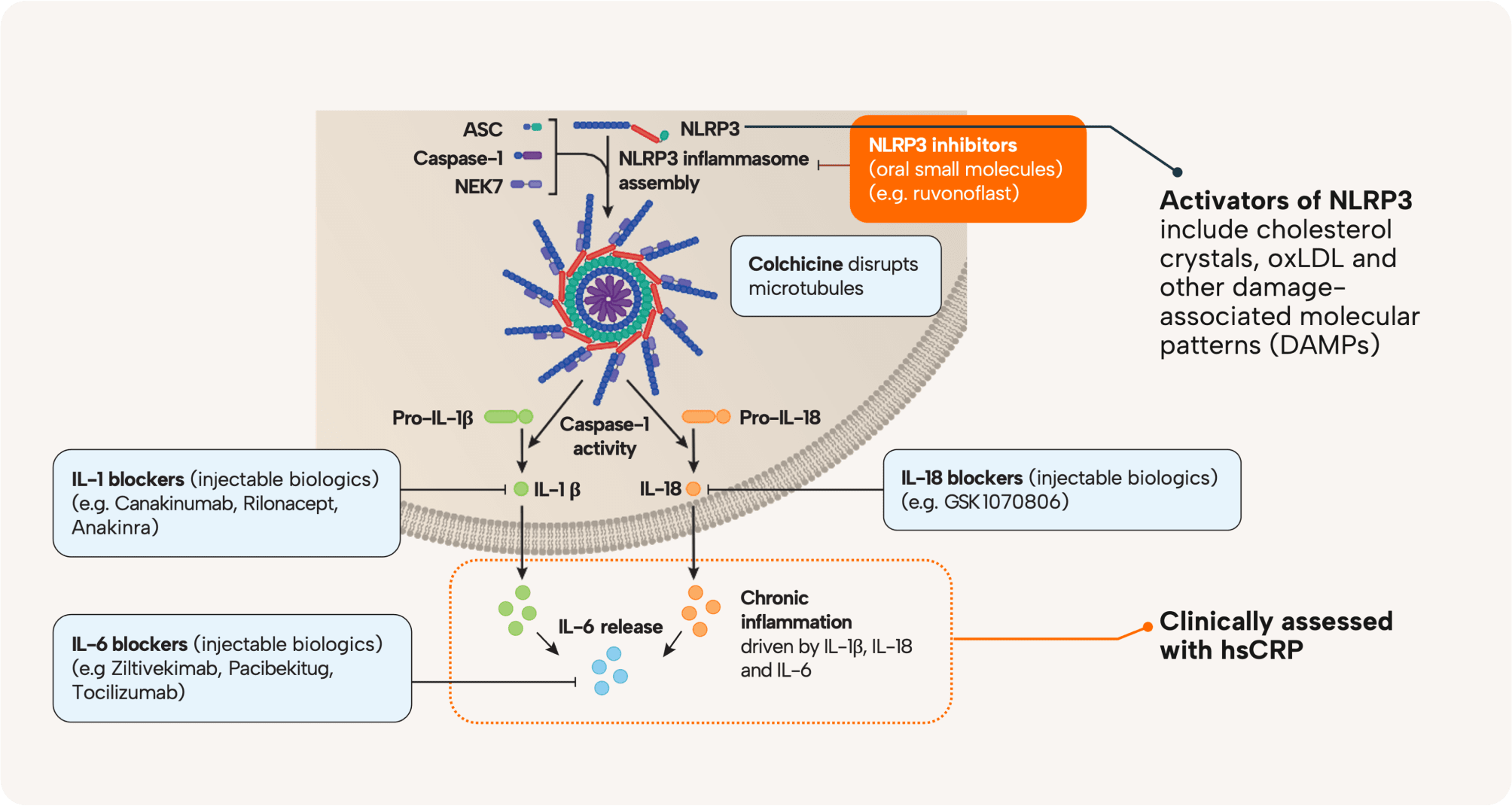
A tissue-penetrant NLRP3 inhibitor would test this principle more directly (Figure 1). By targeting pathological inflammasome activation within disease-relevant inflammatory cells, ruvonoflast directly reduces maturation of both IL-1β and IL-18 at their source, while also attenuating downstream IL-6 and hsCRP signalling. The therapeutic hypothesis is that direct NLRP3 inhibition with ruvonoflast can provide more precise – and potentially more complete – modulation of plaque-associated inflammation than broad downstream cytokine blockade or colchicine’s indirect, multi-mechanism approach, with greater potential impact on clinical outcomes.
FIGURE 1
IL-6 sits downstream from NLRP3 and IL-1β in the inflammation hierarchy
References:
Tardif JC, et al. Efficacy and safety of low-dose colchicine after myocardial infarction. N Engl J Med. 2019;381:2497–2505. https://doi.org/10.1056/nejmoa1912388.
Nidorf SM, et al. Colchicine in patients with chronic coronary disease. N Engl J Med. 2020;383:1838–1847. https://doi.org/10.1056/nejmoa2021372.
Jolly SS, et al. Colchicine in acute myocardial infarction. N Engl J Med. 2025;392:633–642. https://doi.org/10.1056/nejmoa2405922.
Leung YY, et al. Colchicine—update on mechanisms of action and therapeutic uses. Semin Arthritis Rheum. 2015;45:341–350. https://doi.org/10.1016/j.semarthrit.2015.06.013.
Martínez GJ, et al. Colchicine acutely suppresses local cardiac production of inflammatory cytokines in patients with an acute coronary syndrome. J Am Heart Assoc. 2015;4:e002128. https://doi.org/10.1161/jaha.115.002128.
Robertson S, et al. Colchicine therapy in acute coronary syndrome patients acts on caspase-1 to suppress NLRP3 inflammasome monocyte activation. Clin Sci (Lond). 2016;130:1237–1246. https://doi.org/10.1042/cs20160090.
Harrison D, et al. Discovery of clinical candidate NT-0796, a brain-penetrant and highly potent NLRP3 inflammasome inhibitor for neuroinflammatory disorders. J Med Chem. 2023;66(21):14897–14911. https://doi.org/10.1021/acs.jmedchem.3c01398.
Ray KK, et al. Anti-Inflammatory Effects of Oral NLRP3 Inhibition With Ruvonoflast Among Individuals at Elevated Cardiovascular Risk. J Am Coll Cardiol. 2026:S0735-1097(26)06570-8. https://doi.org/10.1016/j.jacc.2026.05.014.