

October 6, 2026
ZEUS and the Hierarchy of Inflammation
Kosh Ray, FMedSci, discusses learnings from the ZEUS trial:
NOTE: Kosh Ray is a member of Rezera’s Clinical Advisory Board and a consultant for the company.
The ZEUS trial is among the most important experiments in cardiovascular inflammation since CANTOS, which demonstrated, for the first time, the potential for an anti-inflammatory therapy to reduce major adverse cardiovascular events (MACE). IL-1β blockade with canakinumab reduced MACE by 15% in the overall population and by 25% in patients who achieved an hsCRP level less than 2 mg/L on treatment.
Few inflammatory pathways have accumulated as much convergent human evidence as IL-6, which is located downstream from IL-1β in the NLRP3 pathway. Consistent genetic evidence has accumulated, linking reduced IL-6 signalling with lower ASCVD risk. Yet profound pharmacological inhibition of IL-6 did not reduce cardiovascular events in ZEUS.
It would be a mistake to interpret this result as evidence that the genetics were “wrong,” or that inflammation is unimportant in cardiovascular disease. ZEUS challenges IL-6 as a pharmacological intervention point. Inflammation remains central to the initiation, progression and clinical manifestations of cardiovascular disease. The trial reinforces that inflammatory mediators are not interchangeable: causal involvement in disease is not synonymous with therapeutic leverage once disease is established.
IL-1β and IL-6 participate in overlapping disease pathways but occupy distinct positions within the inflammatory network. IL-1β is a potent upstream mediator of innate-danger signalling. It activates vascular endothelium, increases adhesion-molecule expression, promotes leukocyte recruitment and induces chemokines and secondary cytokines. Crucially, IL-1β can drive substantial downstream amplification. Because much of this biology occurs locally, circulating IL-1β concentrations can be vanishingly low despite consequential activity within diseased tissue.
FIGURE 1
IL-6 sits downstream from NLRP3 and IL-1β in the inflammation hierarchy
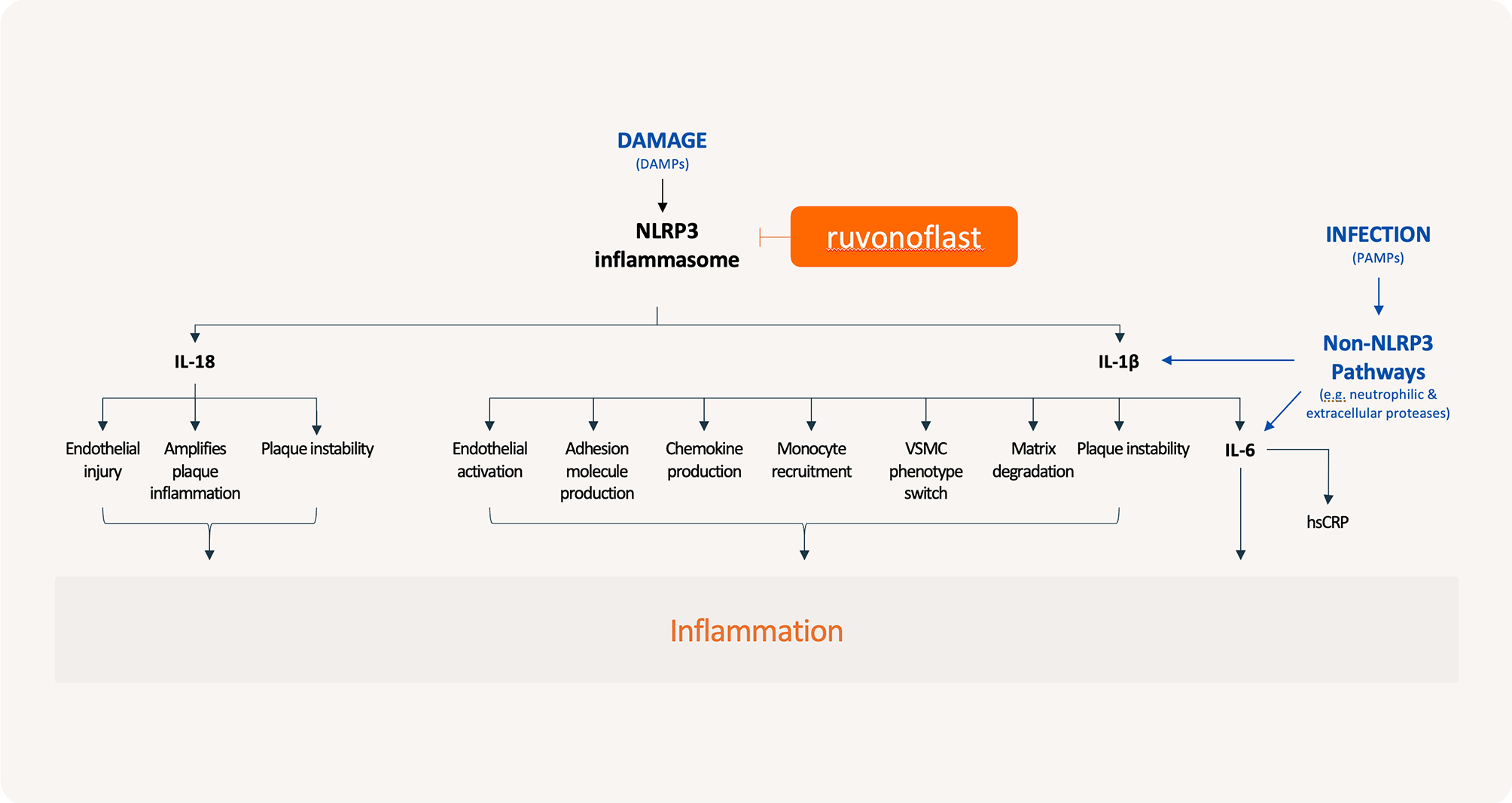
IL-6, by contrast, is an important but pleiotropic response cytokine. It is less directly coupled to this innate inflammatory amplification circuit, circulates more readily and is easily measured in plasma. Elevated IL-6 can reflect infection, tissue injury, obesity, renal disease and other forms of biological stress. It cannot, by itself, identify the anatomical source of inflammation or establish whether IL-6 is acting as an upstream driver, a downstream messenger, a compensatory response or some combination of these roles.
This hierarchy has direct pharmacological consequences. An intervention upstream of IL-6 can attenuate both IL-1β-driven inflammation and part of the downstream IL-6 signal, whereas an intervention at IL-6 does not necessarily extinguish the local danger-signalling and amplification processes that produced it. ZEUS was also conducted in a particularly high-risk population with established ASCVD and advanced CKD, so target selection, patient population, timing and disease stage must all be considered when interpreting the result. The lesson from ZEUS is not to abandon inflammation, but to focus on the hierarchy of inflammation and on intervention points closer to the disease-relevant process within the right tissues.
References:
Novo Nordisk. Novo Nordisk provides update on the ZEUS phase 3 trial in people with ASCVD, CKD and inflammation. July 31, 2026. Available here.
Ridker PM, et al. Antiinflammatory Therapy with Canakinumab for Atherosclerotic Disease. N Engl J Med. 2017;377(12):1119-1131. https://doi.org/10.1056/nejmoa1707914.
Ridker PM, et al. Relationship of C-reactive protein reduction to cardiovascular event reduction following treatment with canakinumab: a secondary analysis from the CANTOS randomised controlled trial. Lancet. 2018;391(10118):319-328. https://doi.org/10.1016/s0140-6736(17)32814-3.
Interleukin-6 Receptor Mendelian Randomisation Analysis (IL6R MR) Consortium et al. The interleukin-6 receptor as a target for prevention of coronary heart disease: a mendelian randomisation analysis. Lancet. 2012;379(9822):1214-24. doi: 10.1016/S0140-6736(12)60110-X.
IL6R Genetics Consortium Emerging Risk Factors Collaboration et al. Interleukin-6 receptor pathways in coronary heart disease: a collaborative meta-analysis of 82 studies. Lancet. 2012;379(9822):1205-13. doi: 10.1016/S0140-6736(11)61931-4.
Ridker PM. From C-Reactive Protein to Interleukin-6 to Interleukin-1: Moving Upstream To Identify Novel Targets for Atheroprotection. Circ Res. 2016;118(1):145-56. https://doi.org/10.1161/circresaha.115.306656.